[How To] Run Bidirectional LSTM in Python

This is a sample program to run bidirectional LSTM in Python using Tensorflow. The complete code repository is available at https://github.com/devharsh/LSTM-Demo.
Code:
#!/usr/bin/env python3
# -*- coding: utf-8 -*-
"""
Created on Wed Jun  1 13:34:00 2022.

@author: devharsh
"""

import matplotlib.pyplot as plt
from pandas import read_csv
from sklearn.model_selection import train_test_split
from sklearn.preprocessing import LabelEncoder
from tensorflow import keras
from tensorflow.keras import layers

inputs = keras.Input(shape=(None,), dtype="float64")
xem = layers.Embedding(101, 128)(inputs)
xl1 = layers.Bidirectional(layers.LSTM(64, return_sequences=True))(xem)
xl2 = layers.Bidirectional(layers.LSTM(64))(xl1)
outputs = layers.Dense(1, activation="sigmoid")(xl2)
model = keras.Model(inputs, outputs)
model.summary()

dataframe = read_csv("sonar.csv", header=None)
dataframe *= 100

encoder = LabelEncoder()
encoder.fit(dataframe[60])
dataframe[60] = encoder.transform(dataframe[60])

print(dataframe.head)
print(dataframe.columns)
print(dataframe.dtypes)

dataset = dataframe.values
X = dataset[:, 0:60].astype(float)
Y = dataset[:, 60]

x_train, x_test, y_train, y_test = train_test_split(X, Y, test_size=0.2)

model.compile(optimizer="adam", loss="binary_crossentropy", metrics=["accuracy"])
history = model.fit(
    x_train, y_train, batch_size=64, epochs=32, validation_data=(x_test, y_test)
)

labels = ["loss", "val_loss"]
for lab in labels:
    plt.plot(history.history[lab], label=lab)
plt.legend()
plt.show()
Output:
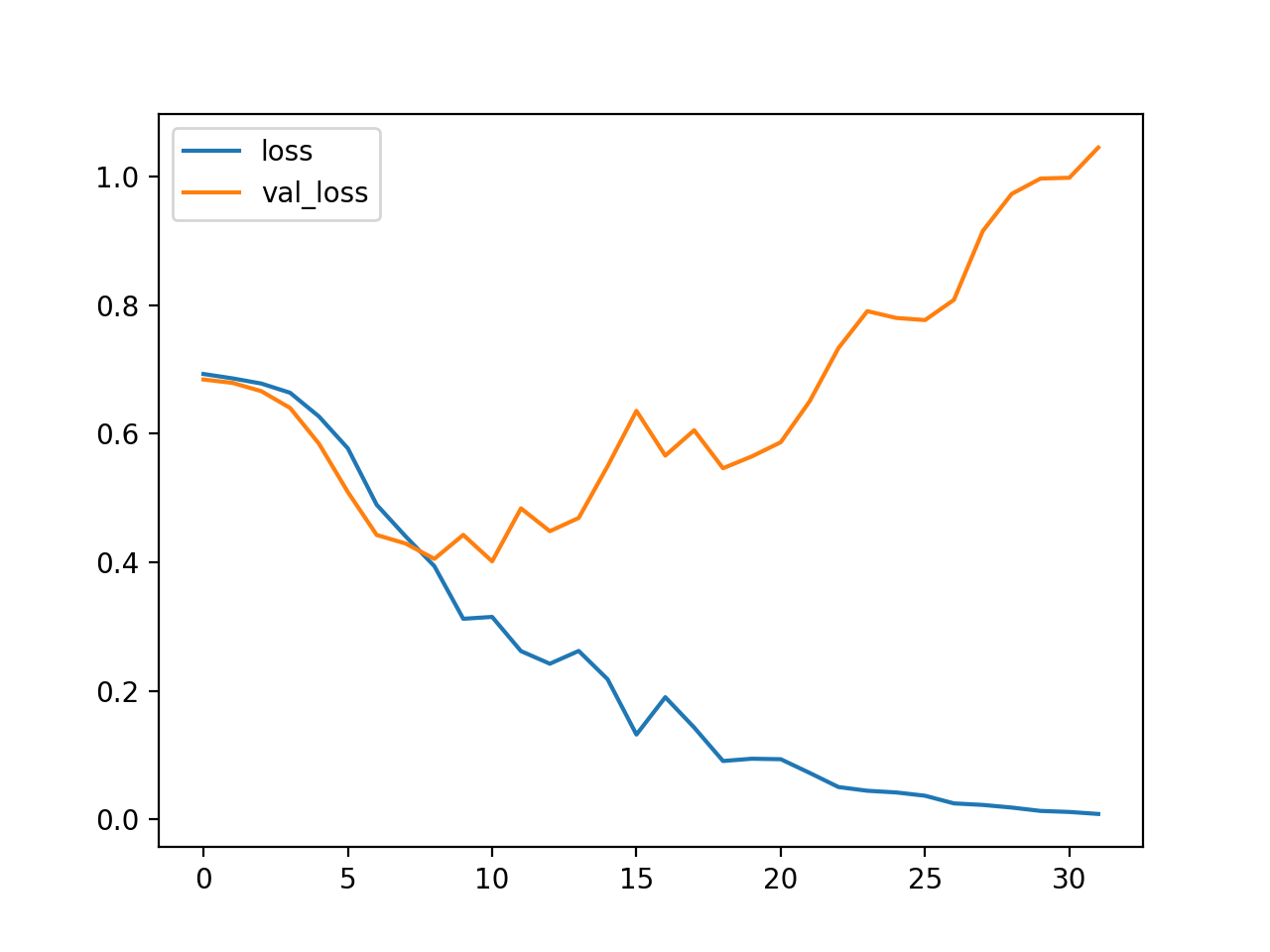
This is a sample program that trains a bidirectional LSTM in Python with TensorFlow, with the full code in the linked repository. An LSTM is a recurrent network suited to sequences, and the bidirectional variant reads the sequence both forwards and backwards.
Reading in both directions lets the model use context from the whole sequence at each step, which often helps on classification tasks. It is a compact, runnable example to learn from and adapt.


Comments
Post a Comment